+86-28-82633987
| Catalog No | Product Description | CAS No. | Purity | Structural Formula |
|---|---|---|---|---|
| BP0806 |
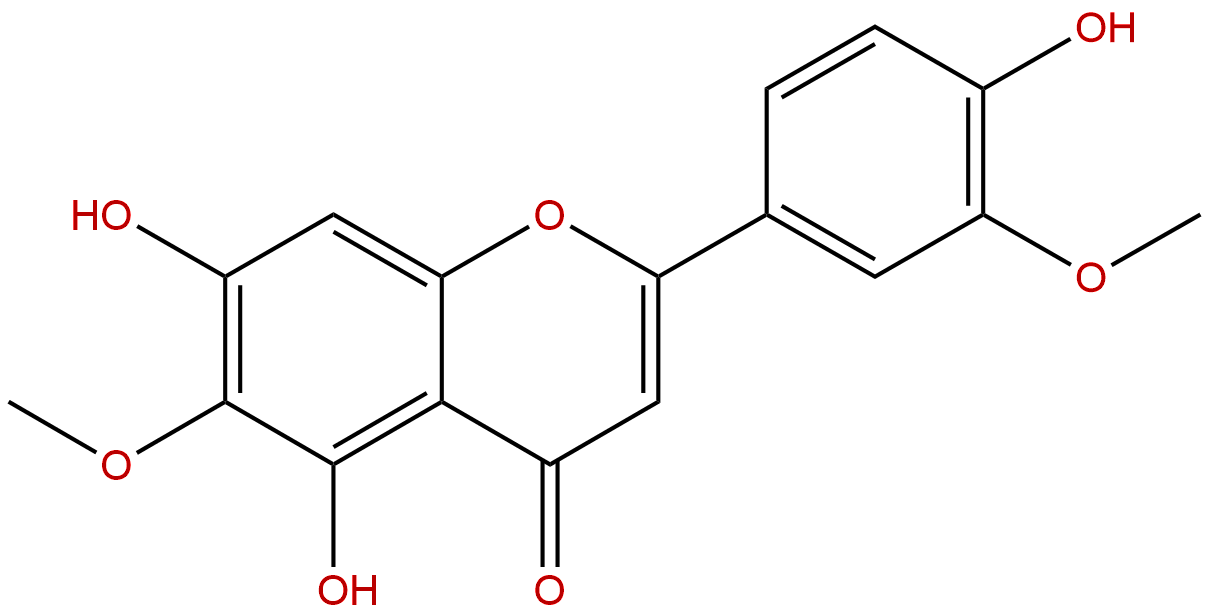
Jaceosidin
Jaceosidin has immunosuppressive, anti-oxidative, anti-inflammatory, and anticancer activities, it is also a microglial inhibitor with anti-neuroinflammation activity. Jaceosidin modulates the ERK/ATM/Chk1/2 pathway, leading to inactivation of the Cdc2-cyclin B1 complex, followed by G2/M cell cycle arrest in endometrial cancer cells. Jaceosidin inhibits T cell proliferation and activation, which is closely associated with its potent down-regulation of the IFN-γ/STAT1/T-bet signaling pathway. Jaceosidin is a trihydroxyflavone that is flavone with hydroxy groups at positions 5, 7 and 4' and methoxy groups at positions 3' and 6. Isolated from Salvia tomentosa and Artemisia asiatica, it exhibits anti-allergic, anti-inflammatory and apoptosis inducing activties. It has a role as a metabolite, an antineoplastic agent, an anti-allergic agent, an anti-inflammatory agent and an apoptosis inducer. It is a dimethoxyflavone and a trihydroxyflavone.
|
18085-97-7 | 98% |
|
| BP0033 |
Inulicin
Inulicin is a terpene lactone.
|
33627-41-7 | 98% |

|
| BP0746 |
Hydroxytyrosol
Hydroxytyrosol is a member of the class of catechols that is benzene-1,2-diol substituted by a 2-hydroxyethyl group at position 4. Isolated from Olea europaea, it exhibits antioxidant and antineoplastic activities. It has a role as an antioxidant, a metabolite and an antineoplastic agent. It is a primary alcohol and a member of catechols. It is functionally related to a 2-(4-hydroxyphenyl)ethanol.
|
10597-60-1 | 98% |

|
| BP5329 |
δ-Tocopherol
Delta-tocopherol is a tocopherol in which the chroman-6-ol core is substituted by a methyl group at position 8. It is found particularly in maize (corn) oil and soya bean (soybean) oils. It has a role as a plant metabolite and a food antioxidant. It is a tocopherol and a vitamin E.
|
119-13-1 | 98% |

|
| BP0221 |
Aurantioobtusin
Aurantio-obtusin is a trihydroxyanthraquinone that is 1,3,7-trihydroxy-9,10-anthraquinone which is by methoxy groups at positions 2 and 8, and by a methyl group at position 6.
|
67979-25-3 | 98% |

|
| SBP00137 |
Pinostrobin chalcone
Pinostrobin chalcone is a potent inhibitor of triglyceride accumulation, it can inhibit adipogenesis in 3T3-L1 cells, it may have anti-obesity effects through the inhibition of adipogenesis. Pinostrobin chalcone displays very remarkable cytotoxic activity against the human cancer cells, such as KB, MCF7 and Caski cells (IC50 values of 6.2, 7.3 and 7.7 ug/mL, respectively).
|
18956-15-5 | 98% |

|
| BP0529 |
Ellagic Acid
Ellagic acid is an organic heterotetracyclic compound resulting from the formal dimerisation of gallic acid by oxidative aromatic coupling with intramolecular lactonisation of both carboxylic acid groups of the resulting biaryl. It is found in many fruits and vegetables, including raspberries, strawberries, cranberries, and pomegranates. It has a role as an EC 2.7.7.7 (DNA-directed DNA polymerase) inhibitor, a geroprotector, an antioxidant, an EC 5.99.1.2 (DNA topoisomerase) inhibitor, an EC 5. Ellagic acid is a potent and ATP-competitive CK2 inhibitor, with an IC50 of 40 nM and a Ki of 20 nM. Ellagic acid has anti-inflammatory, antiproliferative and antioxidant properties, it can prevent cognitive and LTP deficits and also prevent brain inflammation following TBI. Ellagic acid reduced the expression of NO, MDA, IL-1β, TNF-α, COX-2 and NF-κB, and induced the production of GSH and IL-10.
|
476-66-4 | 98% |

|
| SBP03473 | 501086-15-3 |

|
||
| BP0347 | 19993-32-9 | 98% |

|
|
| SBP03010 | 152464-78-3 |

|
||
| BP5212 | 55332-76-8 |

|
||
| BP0358 |
CiMigenol 3-beta-D-xylopyranoside
Cimigenol is a potential antitumor compound, combination of it with an autophagy inhibitor may be a valuable strategy for the chemoprevention or treatment of colon cancer. It exerted potent cytotoxic activity against SMMC-7721 (7.87 µM) and A-549 (12.16 µM). Cimigenol 3-O-beta-D-xylopyranoside is a cucurbitacin and a glycoside. It has a role as a metabolite.
|
27994-11-2 | 98% |

|
| SBP02859 | 16049-28-8 |

|
||
| BP4064 | 62512-20-3 | 98% |

|
|
| SBP00089 | 80787-59-3 |

|
||
| BP0280 |
Bornyl acetate
Bornyl acetate shows highly active whitening and antioxidant activities, has potential applications in cosmeceutical materials. Bornyl acetate has anti-inflammatory activity, may be developed as a preventive agent for lung inflammatory diseases and osteoarthritis; it also has an antiabortive effect through modulation of immunological balance at maternal-fetal interface.
|
76-49-3 | 98% |

|
| SBP03538 |
Pilloin
Luteolin 4',7-dimethyl ether is a dimethoxyflavone, a 3'-hydroxyflavonoid and a dihydroxyflavone. Pilloin exerts a cytotoxic action targeted at the transformed lymphoblasts.
|
32174-62-2 | 98% |

|
| SBP00053 | 22549-21-9 |

|
||
| BP1654 |
Paederosidic acid
Paederosidic acid has significant anti-tumor, anticonvulsant and sedative effects. Paederosidic acid increases brain gamma-aminobutyric acid and decreases glutamic acid in the brain, and it up-regulates expressions of GAD 65, may be a promising future therapeutic agent for treatment of epilepsy.
|
18842-98-3 | 98% |

|
| BP4060 | 22416-58-6 | 98% |

|




 Shenshuai
 Wenjing
 Hedandan






