+86-28-82633987
| Catalog No | Product Description | CAS No. | Purity | Structural Formula |
|---|---|---|---|---|
| BP0806 |
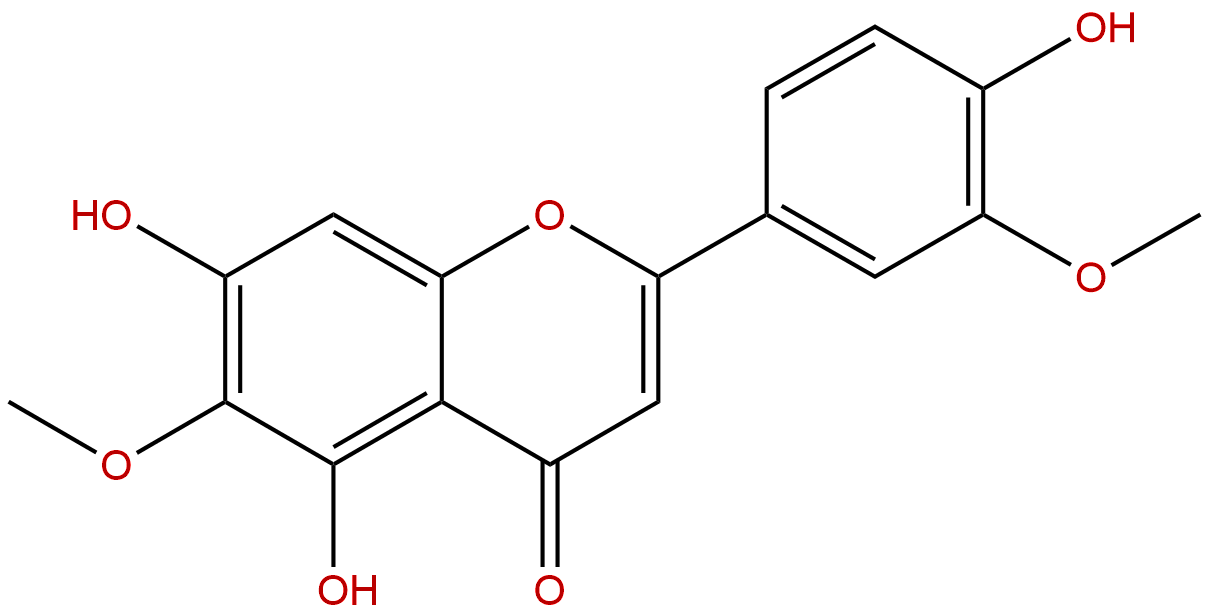
Jaceosidin
Jaceosidin has immunosuppressive, anti-oxidative, anti-inflammatory, and anticancer activities, it is also a microglial inhibitor with anti-neuroinflammation activity. Jaceosidin modulates the ERK/ATM/Chk1/2 pathway, leading to inactivation of the Cdc2-cyclin B1 complex, followed by G2/M cell cycle arrest in endometrial cancer cells. Jaceosidin inhibits T cell proliferation and activation, which is closely associated with its potent down-regulation of the IFN-γ/STAT1/T-bet signaling pathway. Jaceosidin is a trihydroxyflavone that is flavone with hydroxy groups at positions 5, 7 and 4' and methoxy groups at positions 3' and 6. Isolated from Salvia tomentosa and Artemisia asiatica, it exhibits anti-allergic, anti-inflammatory and apoptosis inducing activties. It has a role as a metabolite, an antineoplastic agent, an anti-allergic agent, an anti-inflammatory agent and an apoptosis inducer. It is a dimethoxyflavone and a trihydroxyflavone.
|
18085-97-7 | 98% |
|
| BP0001 |
1,2,3,4,6-Pentagalloylglucose
1,2,3,4,6-pentakis-O-galloyl-beta-D-glucose is a galloyl-beta-D-glucose compound having five galloyl groups in the 1-, 2-, 3-, 4- and 6-positions. It has a role as a geroprotector, an antineoplastic agent, a radical scavenger, a hepatoprotective agent, a radiation protective agent, an anti-inflammatory agent and a plant metabolite. It is a galloyl beta-D-glucose and a gallate ester. It is a conjugate acid of a 1,2,3,4,6-pentakis-O-galloyl-beta-D-glucose(1-).
|
14937-32-7 | 98% |

|
| BP0687 |
Gossypol
Gossypol is an effective natural antimicrobial agent against a wide range of potential fungal pathogens of cotton.Gossypol shows a significant increase in accumulation of acidic vesicular organelle, is a promising drug that induces autophagic cell death in radioresistant malignant glioma.Gossypol binds to Bcl-xL protein and Bcl-2 protein with Kis of 0.5-0.6 μM and 0.2-0.3 mM, respectively. Gossypol is an aldehyde, a hydroxynaphthalene, a polyphenol and a hexol. It has a role as an antispermatogenic agent, an anti-inflammatory agent and a plant metabolite.
|
303-45-7 | 98% |

|
| BP0171 |
Angelicin
Angelicin is a furanocoumarin.
Angelicin has anti-cancer, antiviral, and anti-inflammatory activities;it regulates LPS-induced inflammation via inhibiting MAPK/NF-κB pathways. Angelicin is a powerful inducer of erythroid differentiation and -globin mRNA accumulation of human leukemia K562 cells, it is a potential therapeutic approach in hematological disorders, including -beta-thalassemia and sickle cell anemia.
ngelicin is a type of furan coumarin NF - κ B and MAPK signaling inhibitor with anti-inflammatory, antiviral, and anti-tumor activities. Angelicin can inhibit the lysis and replication of gamma herpesvirus (such as MHV-68), act in the early stages of viral infection, and may inhibit RTA gene expression (IC50=28.95 μ M). Angelicin also alleviates inflammatory responses by inhibiting NF - κ B phosphorylation and nuclear translocation, as well as inhibiting p38 and JNK phosphorylation. Angelicin downregulates anti apoptotic proteins (such as Bcl-2, Bcl xL, and Mcl-1) and activates caspase-9 and caspase-3 to induce apoptosis in neuroblastoma cells.
|
523-50-2 | 98% |

|
| BP0140 |
Alkannin
Alkannin is a hydroxy-1,4-naphthoquinone.
Alkannin, Found in Alkanna tinctoria as a food coloring agent. Alkannin has anti-cancer activity, inhibits cell cycle, and induces cell apoptosis.Alkannin improves liver inflammation in the Rho kinase pathway.
|
517-88-4 | 98% |

|
| BP0221 |
Aurantioobtusin
Aurantio-obtusin is a trihydroxyanthraquinone that is 1,3,7-trihydroxy-9,10-anthraquinone which is by methoxy groups at positions 2 and 8, and by a methyl group at position 6.
|
67979-25-3 | 98% |

|
| SBP00439 | 73354-15-1 |

|
||
| BP1105 |
Pimpinellin
Pimpinellin has phototoxic, it acts as antagonist of proteins with GABA receptor activity. Pimpinellin has anti- inflammatory, and cytotoxic activities. Pimpinellin also has anti-bacterial activity, it shows inhibitory activity against Mycobacterium tuberculosis strain H37Ra , with MICs of 812 uM and IC50s of 389 uM.
|
131-12-4 | 98% |

|
| BP0002 | 116064-77-8 | 98% |

|
|
| BP0250 |
Berbamine Hydrochloride
Berbamine hydrochloride and Ver block the calcium-induced contraction of depolarized pig coronary artery strips, indicate that it may competitively antagonize the action of calcium.
|
6078-17-7 | 98% |

|
| SBP03419 | 57457-99-5 |

|
||
| BP0290 |
Bufotalin
Bufotalin is a steroid lactone. It is functionally related to a bufanolide.
|
471-95-4 | 98% |

|
| BP0712 |
Helenine
Alantolactone is a sesquiterpene lactone that is 3a,5,6,7,8,8a,9,9a-octahydronaphtho[2,3-b]furan-2-one bearing two methyl substituents at positions 5 and 8a as well as a methylidene substituent at position 3. It has a role as an antineoplastic agent, an apoptosis inducer and a plant metabolite. It is a sesquiterpene lactone, a naphthofuran and an olefinic compound.
|
546-43-0 | 98% |

|
| BP0193 |
Aristolochic Acid B
Aristolochic acid B is an aristolochic acid that is phenanthrene-1-carboxylic acid substituted by a methylenedioxy group at the 3,4 positions and by a nitro group at position 10. It has a role as a metabolite, a mutagen, a carcinogenic agent and a nephrotoxin. It is a member of aristolochic acids, a monocarboxylic acid, an aromatic ether, a C-nitro compound, an organic heterotetracyclic compound and a cyclic acetal.
Aristolochic acid B, one of the major components of the carcinogenic plant extract aristolochic acid, is known to be mutagenic and to form DNA adducts in vitro and in vivo, AAII shows more carcinogenic risk than aristolochic acid I, and this may be, at least partly, the result of its increased levels in kidney and plasma.
Aristolochic acid B is an orally active major component of aristolochic acid (AA). Aristolochic acid B can be isolated from plants of the Aristolochia genus. Aristolochic acid B can form DNA adducts. Aristolochic acid B has mutagenicity. Aristolochic acid B exhibits a greater carcinogenic risk in vivo than Aristolochic acid I (HY-N0510).
|
475-80-9 | 98% |

|
| SBP00814 | 390362-51-3 |

|
||
| SBP00968 | 221150-19-2 |

|
||
| BP4234 |
2'-Desoxyuridine
2'-deoxyuridine is a pyrimidine 2'-deoxyribonucleoside having uracil as the nucleobase. It has a role as a mouse metabolite, a Saccharomyces cerevisiae metabolite, an Escherichia coli metabolite and a human metabolite. It is functionally related to a uracil.
|
951-78-0 | 98% |

|
| SBP00261 | 82508-34-7 |

|
||
| BP0417 | 1398-78-3 |

|
||
| BP0308 |
Camptothecin
Camptothecin is a pyranoindolizinoquinoline that is pyrano[3',4':6,7]indolizino[1,2-b]quinoline which is substituted by oxo groups at positions 3 and 14, and by an ethyl group and a hydroxy group at position 4 (the S enantiomer). It has a role as an antineoplastic agent, an EC 5.99.1.2 (DNA topoisomerase) inhibitor, a genotoxin and a plant metabolite. It is a delta-lactone, a quinoline alkaloid, a tertiary alcohol and a pyranoindolizinoquinoline. Camptothecin is a specific inhibitor of DNA topoisomerase I (Topo I) with IC50 of 0.68 μM; it is a novel alkaloidal leukemia and tumor inhibitor, is a strong inhibitor of nucleic acid synthesis in mammalian cells and a potent inducer of strand breaks in chromosomal DNA. Camptothecin and its analogs reduce amyloid-β production and amyloid-β42-induced IL-1β production.
|
7689-03-4 | 98% |

|




 Shenshuai
 Wenjing
 Hedandan






