+86-28-82633987
| Catalog No | Product Description | CAS No. | Purity | Structural Formula |
|---|---|---|---|---|
| BP0806 |
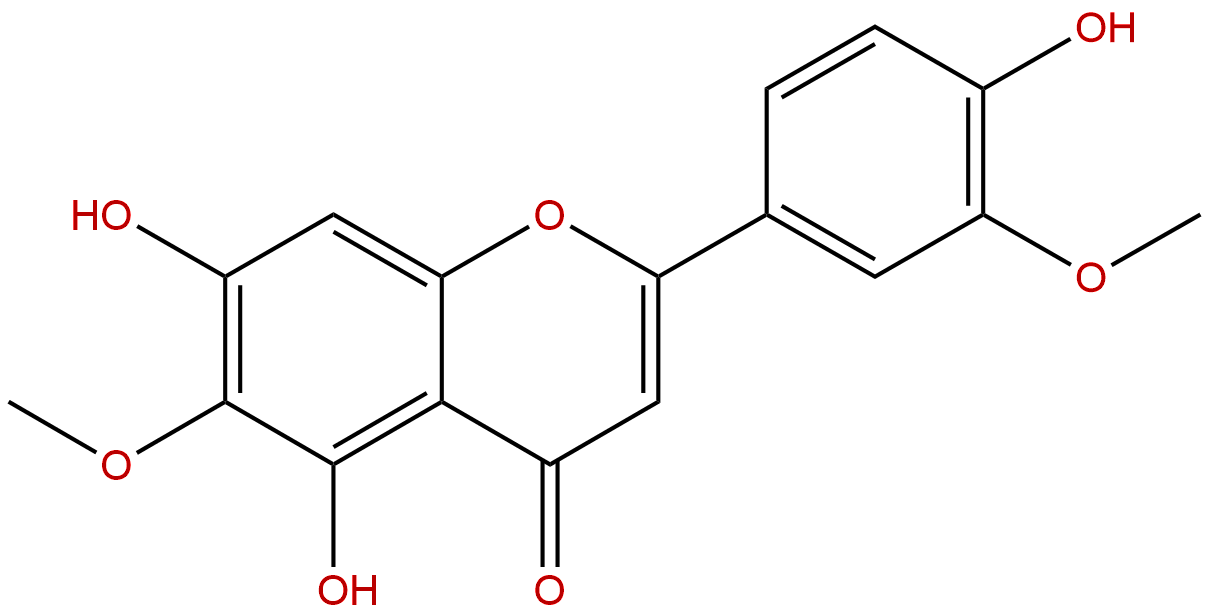
Jaceosidin
Jaceosidin has immunosuppressive, anti-oxidative, anti-inflammatory, and anticancer activities, it is also a microglial inhibitor with anti-neuroinflammation activity. Jaceosidin modulates the ERK/ATM/Chk1/2 pathway, leading to inactivation of the Cdc2-cyclin B1 complex, followed by G2/M cell cycle arrest in endometrial cancer cells. Jaceosidin inhibits T cell proliferation and activation, which is closely associated with its potent down-regulation of the IFN-γ/STAT1/T-bet signaling pathway. Jaceosidin is a trihydroxyflavone that is flavone with hydroxy groups at positions 5, 7 and 4' and methoxy groups at positions 3' and 6. Isolated from Salvia tomentosa and Artemisia asiatica, it exhibits anti-allergic, anti-inflammatory and apoptosis inducing activties. It has a role as a metabolite, an antineoplastic agent, an anti-allergic agent, an anti-inflammatory agent and an apoptosis inducer. It is a dimethoxyflavone and a trihydroxyflavone.
|
18085-97-7 | 98% |
|
| BPF2172 |
Quercetin 3-O-β-D-glucuronide
Quercetin is one of the most prominent dietary antioxidants, it is claimed to exert beneficial health effects, this includes protection against various diseases such as osteoporosis, certain forms of cancer, pulmonary and cardiovascular diseases but also against aging. It is a stimulator of recombinant SIRT1 and also a PI3K inhibitor with IC50 of 2.4±0.6 μM, 3.0±0.0 μM and 5.4±0.3 μM for PI3K γ, PI3K δ and PI3K β, respectively. It also attenuated the function VEGFR, androgen receptor and the expressions of NF-κB, IL Receptor, FAK, ERK,Nrf2. Miquelianin is a quercetin O-glycoside that consists of quercetin attached to a beta-D-glucuronopyranosyl moiety at position 3 via a glycosidic linkage. Isolated from Salvia and Phaseolus vulgaris, it exhibits antioxidant and antidepressant activities. It has a role as an antioxidant, a metabolite and an antidepressant. It is a beta-D-glucosiduronic acid and a quercetin O-glycoside.
|
22688-79-5 | 98% |

|
| BP1471 |
Camelliaside B
Camelliaside B is a natural product from Camellia oleifera Abel. Camelliaside b is a glycoside and a member of flavonoids.
|
131573-90-5 | 98% |

|
| BP1470 |
Camelliaside A
Camelliaside A is a natural product from Camellia oleifera Abel.
|
135095-52-2 | 98% |

|
| BP5408 | 136172-60-6 | 98% |

|
|
| BPF2304 |
Neoeriocitrin
Neoeriocitrin is a flavanone glycoside that is eriodictyol substituted by a 2-O-(6-deoxy-alpha-L-mannopyranosyl)-beta-D-glucopyranosyl residue at position 7 via a glycosidic linkage. It has a role as a plant metabolite. It is a member of 4'-hydroxyflavanones, a neohesperidoside, a trihydroxyflavanone, a disaccharide derivative and a flavanone glycoside. It is functionally related to an eriodictyol. Neoeriocitrin has antioxidant capacity, it could rescue the inhibition effect of cell differentiation induced by PD98059 to some degree.Neoeriocitrin may be a new promising candidate drug for treatment of osteoporosis.
|
13241-32-2 | 98% |

|
| SBP03818 |
(+)-Borneol
(+)-Borneol is a bicyclic monoterpene used for analgesia and anaesthesia in traditional Chinese and Japanese medicine, it and its enantiomer (-)-borneol have a highly efficacious positive modulating action at GABA(A) receptors at human recombinant alpha1beta2gamma2L GABA(A) receptors. Borneol specifically inhibits the nicotinic acetylcholine receptor (nAChR)-mediated effects in a noncompetitive way, can depress P-glycoprotein function by a NF-κB signaling mediated mechanism in a blood brain barrier in vitro model. Borneol has neuroprotection through the inhibition of IκBα-NF-κB and translocation signaling pathway, it also has an anti-cerebral ischemia effects. It can suppresse inflammatory responses in LPS-induced acute lung injury through inhibition of the NF-κB and MAPKs signaling pathways. (+)-borneol is a borneol. It is an enantiomer of a (-)-borneol.
|
464-43-7 | 98% |

|
| BP0899 |
Luteoloside
Luteolin 7-O-beta-D-glucoside is a glycosyloxyflavone that is luteolin substituted by a beta-D-glucopyranosyl moiety at position 7 via a glycosidic linkage. It has a role as an antioxidant and a plant metabolite. It is a beta-D-glucoside, a trihydroxyflavone, a glycosyloxyflavone and a monosaccharide derivative. It is functionally related to a luteolin. It is a conjugate acid of a luteolin 7-O-beta-D-glucoside(1-).
|
5373-11-5 | 98% |

|
| BP5278 | 113558-11-5 | 98% |

|
|
| BP3412 |
Methyl gallate
Methyl Gallate is a plant polyphenol with antioxidant, anticancer, anti-bacterial, and anti-inflammatory activities.Methyl gallate is a potent and highly specific inhibitor of herpes simplex virus in vitro. Methyl gallate also has a dual cyclooxygenase-2/5-lipoxygenase inhibitory activity. Methyl gallate can inhibit the growth of oral pathogens and S. mutans biofilm formation, and may be used to prevent the formation of oral biofilms. Methyl 3,4,5-trihydroxybenzoate is a gallate ester obtained by the formal condensation of gallic acid with methanol. It exhibits anti-oxidant, anti-tumor, anti-microbial and anti-inflammatory properties. It has a role as an antioxidant, an anti-inflammatory agent and a plant metabolite.
|
99-24-1 | 98% |

|
| SBP03357 |
β-Tocopherol
Beta-tocopherol is a tocopherol in which the chroman-6-ol core is substituted by methyl groups at positions 5 and 8. While it is found in low concentrations in many vegetable oils, only cottonseed oil contains significant amounts. It has a role as a plant metabolite and a food component. It is a tocopherol and a vitamin E.
|
148-03-8 | 98% |

|
| BP1069 |
Pectolinarigenin
Pectolinarigenin possesses anti-inflammatory, antiallergic and hepatoprotective activities.It is a dual inhibitor of COX-2/5-LOX,and the IC50 >1 microM; it also can increase activity levels of GSH, GR, GCS, and GST, as well as SOD. Pectolinarigenin is a dimethoxyflavone that is the 6,4'-dimethyl ether derivative of scutellarein. It has a role as a plant metabolite. It is a dimethoxyflavone and a dihydroxyflavone. It is functionally related to a scutellarein.
|
520-12-7 | 98% |

|
| BP1347 |
Sulforaphane
Sulforaphane is a cruciferous vegetable-derived isothiocyanate with promising antitumor, chemopreventive and therapeutic activities, it inhibits TPA-induced NF-κB activation and COX-2 expression in MCF-10A cells by blocking two distinct signaling pathways mediated by ERK1/2-IKKα and NAK-IKKβ. Sulforaphane may exert a significant neuroprotective effect on cholinergic deficit and cognitive impairment, it also has anti-inflammatory effect, at least ,in part,associated with interfering with the NF-κB pathway. (R)-sulforaphane is a sulforaphane in which the sulfinyl group has R configuration. Naturally occurring compound found in brocolli that acts as a potent inducer of phase II detoxification enzymes. It is an enantiomer of a (S)-sulforaphane.
|
142825-10-3 | 98% |

|
| BP0796 |
Isorhamnetin-3-O-beta-D-Glucoside
Isorhamnetin 3-O-beta-D-glucopyranoside is a glycosyloxyflavone that is isorhamnetin substituted at position 3 by a beta-D-glucosyl residue. It has a role as a metabolite. It is a beta-D-glucoside, a monomethoxyflavone, a trihydroxyflavone, a glycosyloxyflavone and a monosaccharide derivative. It is functionally related to a beta-D-glucose and an isorhamnetin.
|
5041-82-7 | 98% |

|
| BP4393 |
Lirinidine
(+)-Lirinidine has antioxidative activity, and it can significantly inhibit the proliferation of melanoma cells; it also shows potent inhibition of melanogenesis. Lirinidine exhibits significant inhibition of collagen, arachidonic acid and platelet activating factor-induced platelet aggregation.
|
54383-28-7 | 98% |

|
| BP5359 | 3649-76-1 | 98% |

|
|
| BP0537 |
Epiberberine
Epiberberine, a natural protoberberine alkaloid, is a potent inhibitor against both ureases with IC50 values of 3.0±0.01μM for HPU (ureases from Helicobacter pylori) and 2.3±0.01μM for JBU (ureases from jack bean); it also exhibits predominant cholinesterases (ChEs) inhibitory effects with IC(50) values ranging between 0.44-1.07 microM for AChE and 3.32-6.84 microM for BChE. Epiberberine has anti-adipogenic effect is mediated by downregulation of the Raf/MEK1/ERK1/2 and AMPKα/Akt pathways during 3T3-L1 adipocyte differentiation. Epiberberine also ha anti-alzheimer and antioxidant activities.
|
6873-09-2 | 98% |

|
| BP0401 |
Costunolide
Costunolide has antipyretic, anti-inflammatory, anti-oxidant, anti-carcinogenic and anti-fungal activities, it possesses normo-glycemic and hypolipidemic activity. Costunolide inhibits RANKL-induced osteoclast differentiation by suppressing RANKL-mediated c-Fos transcriptional activity; it inhibits IL-1beta gene expression by blocking the activation of MAPKs and DNA binding of AP-1; it also induces the ROS-mediated mitochondrial permeability transition and resultant cytochrome c release,. Costunolide is a germacranolide with anthelminthic, antiparasitic and antiviral activities. It has a role as a metabolite, an antiinfective agent, an antiparasitic agent, an anthelminthic drug, an antineoplastic agent and an antiviral drug. It is a heterobicyclic compound and a germacranolide.
|
553-21-9 | 98% |

|
| BP0427 |
Cyanidin-3-O-galactoside chloride
Cyanidin 3-O-beta-D-galactoside chloride is a memeber of the class of anthocyanin chlorides that has cyanidin 3-O-beta-D-galactoside as the cationic counterpart. It contains a cyanidin 3-O-beta-D-galactoside. Cyanidin-3-O-galactoside chloride has anti-obesity and hypolipidemic effects.
|
27661-36-5 | 98% |

|
| BP4900 |
Salvianolic acid E
Salvianolic acid E is a natural product from Salvia miltiorrhiza Bge.
|
142998-46-7 | 98% |

|




 Shenshuai
 Wenjing
 Hedandan






